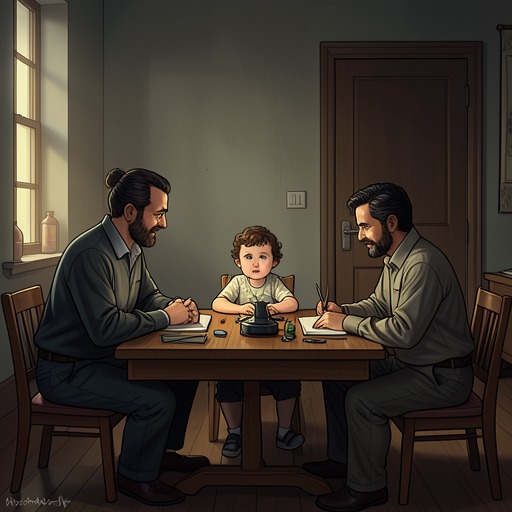
Peter Radley and Will Radley's brotherhood
The RadleysPeter Radley and Will Radley are brothers whose relationship joins inherited identity to a history of rescue, loss, and mutual influence. Will saves Peter during the attack that kills their parents, then helps secure them a home; as they grow up, he also leads his younger brother toward the vampire world’s riskier pleasures. Their adult bond is less settled: Peter has been away from Will for a long time, yet when Clara Radley is in trouble he reaches for his brother’s help.
Identity and Family Background
Peter is Will’s younger brother. Their brotherhood belongs to a family history in which vampirism is inherited rather than acquired: when Rowan Radley asks whether Peter was converted, Peter explains that he has always been a vampire and that the Radleys have been so for generations. Will and Peter therefore share not only parents and childhood, but also a condition that sets their family apart from ordinary human life.
Their parents’ deaths make the brothers’ bond a matter of survival from an early age. When Peter was eight and Will was ten, two men broke into the canal barge where the family lived, intending to kill their parents. Peter woke to the attack and remained hidden, terrified, while Will confronted the intruders. The episode establishes an enduring imbalance between them: the younger boy could not act, while his older brother intervened and got him out alive.
Rescue and a Shared Upbringing
After defending Peter, Will led him away from the barge and told him to wait on the riverbank. Peter stayed there as he understood that their parents were dead. Will then set the barge alight and flew the brothers away. The sequence leaves the rescue inseparable from bereavement: Will saves Peter, but cannot preserve the family home or their parents.
Will also took practical responsibility for what came next. About a week later, he contacted the Orphaned Vampire Agency, which found them a home with Arthur and Alice Castle, suburban abstainers. The boys vowed never to turn their adoptive parents into vampires. Their shared childhood thus included both a new domestic refuge and a rule about the limits of what they would do to the people who cared for them.
That protection did not make Will a cautious guide. In their teenage years, he encouraged Peter toward behavior that their later abstainer life would reject. The brothers’ past included trips to London during the red hour, visits to the Stoker Club to watch vampire punk, and performances together in the Hemo Goblins. They also dried their own blood and smoked it before school. Will’s influence widened Peter’s experience of vampire culture, but it also drew him into conduct that sat uneasily beside the restraint their adoptive parents represented.
Influence, Loyalty, and Distance
Peter’s judgment of Will holds two truths together: Will led him astray, and Will saved his life. Neither fact cancels the other. Their shared adventures and music register the intimacy of brothers who grew up together, while Peter’s later assessment refuses to turn that intimacy into uncomplicated approval. The older brother who gave Peter a home and a future was also a formative influence in choices Peter came to view as dangerous.
The distinction between inheritance and conversion further frames their family relationship. Peter’s explanation to Rowan identifies the Radley condition as something passed through generations, rather than something Will or Peter chose to acquire. Their childhood rescue and later upbringing therefore unfold within a family identity that neither brother began by choosing. Their vow not to convert Arthur and Alice shows one boundary they established within that inheritance, even as Will’s adolescent example pulled Peter toward other transgressions.
Estrangement and Renewed Need
Years later, Peter’s call to Will makes the distance between them explicit. After Clara is in trouble, Peter takes out his mobile and leaves a message saying that it has been a long time and that the family needs help. He tells Will that Clara is in trouble and that they cannot manage the situation alone. The appeal is urgent and specific, but its form also acknowledges a break in contact: Peter does not speak as though ordinary closeness has continued uninterrupted.
Helen Radley recognizes whom Peter is calling and stops him, reminding him that he had promised never to phone Will. Their disagreement gives the old bond a present cost. Peter’s decision to reach out runs against a promise made within his marriage, while the family crisis makes the brother he has avoided seem necessary again. The evidence does not resolve why the brothers became distant, but it shows the pressure their history exerts when the Radleys face trouble.
Will’s eventual appearance at the family home confirms the relationship that Peter’s message had invoked. Rowan, who had been told that his parents were only children, is confused by the arrival of an uncle he did not know existed. Peter identifies Will as his brother; Rowan responds with hurt at another concealed family truth. The reunion therefore renews the brothers’ connection while exposing the secrecy surrounding it to the next generation. Will is at once Peter’s rescuer from childhood, his unruly companion in adolescence, and the brother whose return unsettles the family Peter has built.